

All life here began with the capture of a photon.
Billions of years before the first animal breath was drawn, the work of microbes, fungi, and plants reorganized sunlight itself into physical matter. This energetic reorganization created the carbon, the oxygen, and the electrical gradients that power every living cell.
We are not distinct from this lineage. We are literally made of reorganized sunlight, and we inhabit an architecture not of our own design.
Here lies the foundation of the Outer Kingdom: a coalition of ancient lineages—plants, fungi, and microbes—that act as the operating system that animals are derived from. They are energetic engines which create the stability upon which all human life depends.
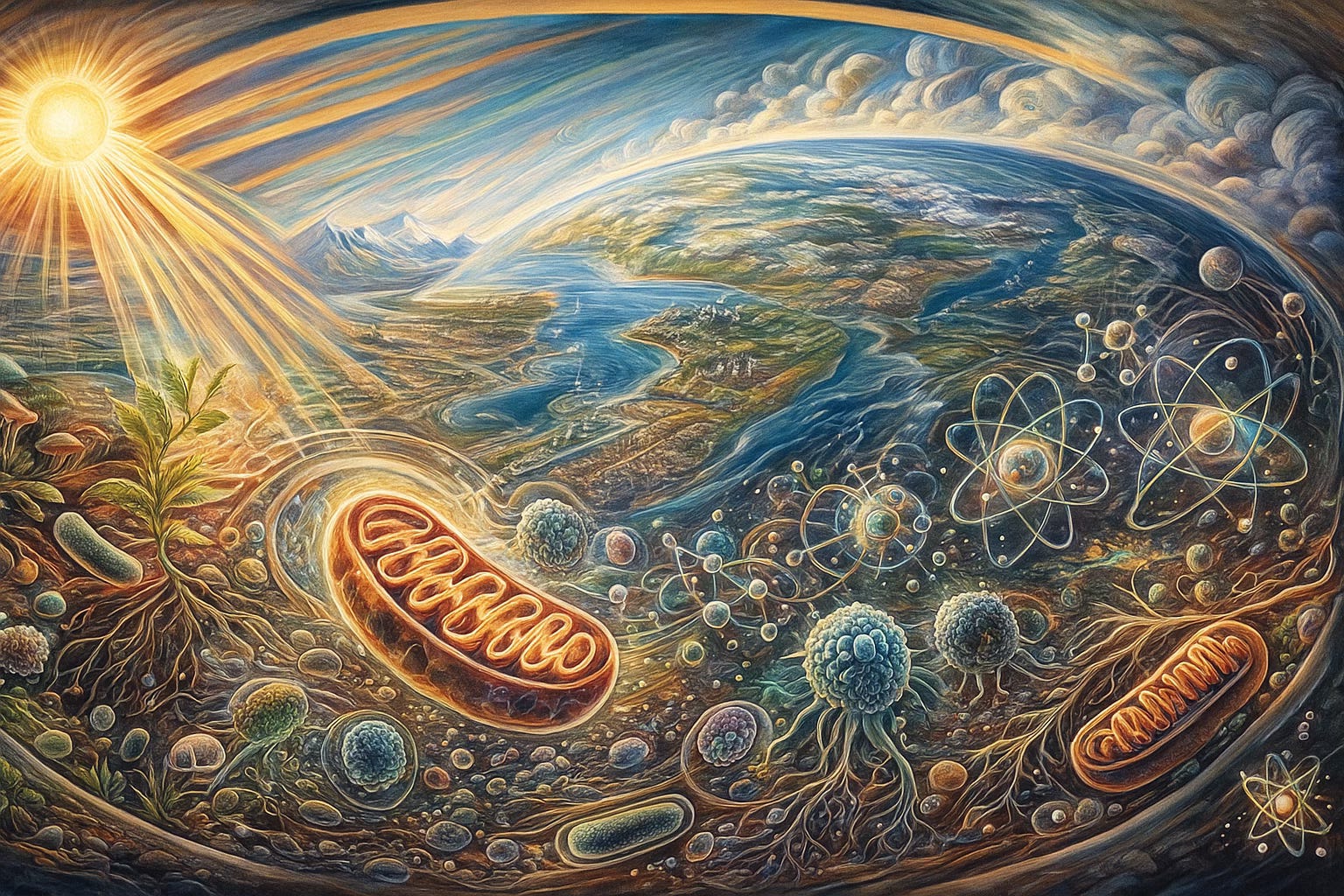
When you zoom in far enough, every one of our cells runs on extreme electrical gradients.
Incredibly, when scaled to distance, the voltages within every living cell are greater than a lightning bolt.1
These voltages separate ions, control mitochondrial polarization and signaling, and tune our immune systems.
And it does more than sustain life. It permits consciousness. It dictates the energy available for thought, for planning, for behavior, and for connection.
What we call “inflammation” is often a tremor in this underlying landscape, a bioelectric terrain that loses its coherence, shifting the solid ground upon which our physiology rests.
This brings us back to the Outer Kingdom.
You are what you eat. Dietary fiber is often dismissed as mere roughage, inert bulk to keep the machine running. But ecologically, it is a vital input channel from the Outer Kingdom. Fiber is a structural archive. Our microbial inhabitants dismantle these complex plant architectures to release metabolites that translate physical matter into the chemical signals that tune our tissues, mitochondria, and immune defense.2
The full complexity of this cascade spans many layers of biology. And the population-level pattern is clear: higher fiber intake is associated with a quieter, more stable physiological terrain. And anything that alters the terrain shifts the distribution of what is physiologically possible.
To map this shifting landscape, I turned to the most recent NHANES data (Aug 2021–Aug 2023). I examined the Systemic Immune–Inflammation Index (SII). SII is a metric derived from immune cells: platelets, neutrophils, and lymphocytes. SII is not a disease diagnosis. It is a population-level gauge of signal versus noise. It is a proxy for how vigilant, or how “keyed up,” a human immune system is.

Variance matters. Across ecology, economics, neuroscience, network engineering, machine learning, physics, and biology alike, systems with lower volatility are more predictable, more efficient, and more capable of adaptive behavior. You do not need a mechanism to see this. You only need the distributions in the chart. The low-fiber state is chaotic and reactive. The high-fiber state is coherent and responsive.
In a high-noise state, the brain plays defense, pruning connections to save energy. This is the biological mechanism of “brain fog.” The body diverts resources from “expensive” long-term cognition (planning, memory, emotional regulation) toward immediate immune defense.
This leaves less energy available for the deep, grounded stability from which our best self arises. Your body feels heavy with fatigue, and yet your mind is left flimsy, lacking the capability to hold its ground against impulses, stress, and noise.
In the quiet state of Deep Stability, the brain shifts to construction and regeneration. The full stack of human functioning becomes available again. That terrain is measurable. It is statistically coherent. And coherence is the prerequisite for every higher-order human capacity we care about.
The NHANES data doesn’t prove causation. But it does show that the people consuming the most fiber occupy a distinct, quieter immune terrain in the United States today:
Across the full NHANES 2021–2023 dataset, the lowest 10% of SII values occur exclusively in the ≥60 g/day fiber group.
No subgroup consuming <14 g/day ever enters that region.
This is a mathematically verified distributional separation, not an interpretation.
In the “State Space” of the immune system (the map of all possible conditions), the region of “Deep Stability” (SII < 200) is topologically inaccessible to the low-fiber physiology.
The door is shut.
This connects directly to Adaptive Resilience.
In the Adaptive Resilience framework, coherence is the foundational property that allows Clarity, Strength, Flow, and Connection to emerge. When physiology is volatile, everything is harder—learning, routines, emotion regulation, planning, social engagement, creativity. When physiology quiets in Deep Stability, the full stack of human functioning becomes available again.
The door is open.
The food we eat either amplifies noise or curates stability. In this dataset, the Outer Kingdom’s fiber, metabolites, and microbial substrates, map to the quietest terrain humans occupy today. When we align ourselves with that ecology we seem to shift into a physiological condition with less noise and better bioelectric stability.
A calmer inflammatory distribution may correspond to a calmer cognitive and emotional baseline. A narrow, stable terrain may reduce the metabolic cost of constant threat monitoring.
That terrain is measurable. It is statistically coherent. And coherence is the beginning of every higher-order human capacity we care about.
When I look at the chart, the message is simple:
The more we align with the Outer Kingdom, the more the terrain quiets.
And when the terrain quiets in Deep Stability, and we regain the conditions required for Adaptive Resilience.
Zorova, L. D., Popkov, V. A., Plotnikov, E. Y., Silachev, D. N., Pevzner, I. B., Jankauskas, S. S., Babenko, V. A., Zorov, S. D., Balakireva, A. V., Juhaszova, M., Sollott, S. J., & Zorov, D. B. (2018). Mitochondrial membrane potential. Analytical biochemistry, 552, 50–59. https://doi.org/10.1016/j.ab.2017.07.009
Koh, A., De Vadder, F., Kovatcheva-Datchary, P., & Bäckhed, F. (2016). From dietary fiber to host physiology: Short-chain fatty acids as key bacterial metabolites. Cell, 165(6), 1332–1345. https://doi.org/10.1016/j.cell.2016.05.041