

Last week I wrote about Deep Stability. When the body, mind, and relationships maintain a steady and predictable internal environment, the immune system becomes calmer, thinking becomes clearer, and emotional life is easier to regulate. The biological cost of constantly scanning for threats drops.
This week I want to examine the opposite condition.
Incoherence.
Incoherence is not how we feel.
It is how systems fail.
I have spent years working at the intersection of complex systems, biology, and technology. What keeps standing out to me is not how fragile people are, but how often their environments exceed what any person can reasonably integrate.
What Incoherence Means
Modern life delivers more sensory, emotional, metabolic, and social input than the human organism evolved to process. We often call this “stress,” but that word hides the deeper mechanism.
Incoherence begins when incoming signals become too large, too fast, or too conflicting for the brain and body to organize reliably.
This is not a failure of willpower or character.
It is a problem of biological capacity.
The human organism is a predictive system. It constantly infers what is happening, updates internal models, and coordinates physiology, cognition, and behavior. When noise exceeds capacity, these layers stop reinforcing one another. They begin to misfire in patterned, measurable ways.
When coherence breaks, your biology is the first to pay the cost.
Incoherence Is Not a Mood
People often describe feeling “out of alignment,” as if incoherence were simply an emotional state.
It is not.
Incoherence has a biology, and biology leaves fingerprints. You can see it in a room before anyone speaks: the shallow breathing, the flushed skin, the micro-movements of eyes scanning for an exit that isn’t there.
When coherence deteriorates, inflammation rises, attention narrows, executive control weakens, decision-making becomes defensive, and long-term health begins to erode.
There is nothing symbolic here.
This is measurable physiology.
Incoherence Is a Threat Physiology
Human survival depended on judging safety with extreme precision. In small cooperative groups, predictability was protection. Unreliable bonds increased the risk of injury, infection, and death.
Across evolutionary time, the brain assembled a distributed system dedicated to answering one continuous question:
Am I safe?
George Slavich’s Social Safety Theory explains that humans evolved immune and neural systems tuned to detect threats that historically predicted physical harm—especially social threats such as rejection, exclusion, conflict, or unpredictability1. The brain does not distinguish these from physical danger.
The immune system does not either.
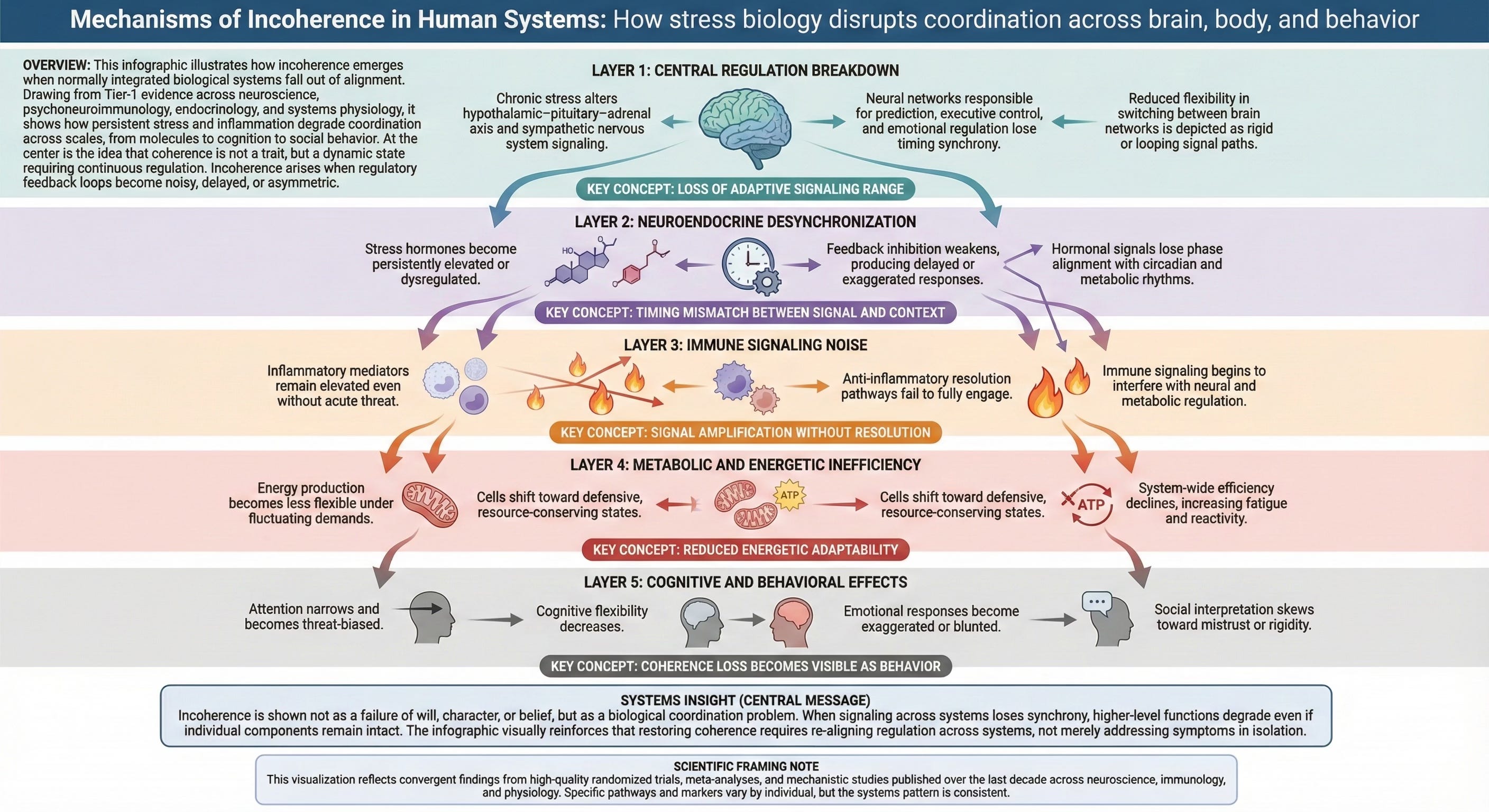
When safety cannot be established, or when signals conflict, the organism shifts into biological defense. Inflammatory signaling increases, stress hormones lose their ability to shut inflammation down, and restorative processes are deprioritized.
This is not stress in the everyday sense.
It is the beginning of a system-level loss of coherence.
I do not interpret this literature as saying that people are weak, broken, or deficient. I read it as evidence that we are exquisitely sensitive organisms operating in conditions that systematically violate the assumptions under which our biology evolved.
How Social Signals Write Biology
Work in human social genomics shows that social environments systematically shape immune gene expression. Chronic social threat shifts the body toward pro-inflammatory programs and away from antiviral and restorative states2.
Signals do not just change feelings.
They change biology.
This provides a molecular explanation for why prolonged uncertainty, conflict, or exclusion can quietly reshape long-term health trajectories.
Immune Signals Change the Brain
Inflammation does more than mark immune status. It changes how the brain allocates attention, motivation, and energy.
Research on “sickness behavior” shows that peripheral immune signals act on the brain to produce fatigue, withdrawal, reduced exploration, and diminished social engagement34. These responses are adaptive during acute illness, but harmful when sustained.
Bidirectional communication between the nervous system and the immune system means that once this state begins, it reinforces itself. Brain-driven stress responses amplify immune activity, and immune signals further alter brain function.
Incoherence becomes self-maintaining.
Inflammation Narrows Cognition
Inflammatory signaling alters neural computation in consistent ways. Attention becomes narrower, executive control weakens, threat bias increases, and cognitive flexibility declines5.
This helps explain why people under chronic physiological threat struggle to imagine alternative futures, tolerate ambiguity, or engage in complex long-term reasoning.
You cannot build the future from a state that cannot perceive one.
Inflammation Reshapes Social Behavior
Experimental studies show that increased inflammatory activity changes how people process social information. Sensitivity to negative social cues increases, interpretation of threat intensifies, and social engagement shifts6 7.
These are not personality traits.
They are state-dependent biological effects.
Over time, these behavioral changes reinforce isolation, misunderstanding, and withdrawal, which further amplify threat physiology.
The Three Layers of Incoherence
Incoherence unfolds across three tightly coupled layers:
Biological incoherence: Inflammation rises, energy shifts toward vigilance, and repair slows.
Cognitive incoherence: Attention narrows, flexibility declines, and threat dominates interpretation.
Relational incoherence: Behavior becomes defensive, cues are misread, and generosity contracts.
What strikes me most is that these layers rarely fail independently. When biology, cognition, and relationships drift out of alignment, people are often told to fix the layer that is most visible. Think differently. Behave better. Communicate more clearly.
The research suggests the opposite. Incoherence is not solved by correcting a single layer in isolation, because the failure is relational across systems.
Why Incoherence Persists
Modern environments destabilize ancient safety cues.
Sleep is fragmented.
Diet is poor.
Movement is minimal.
Social signals are inconsistent.
Information is continuous and contradictory.
Relationships are mediated and unstable.
The surprising fact is not that so many people feel incoherent.
It is that coherence still appears at all.
Coherence Is Not Calm, It Is Alignment
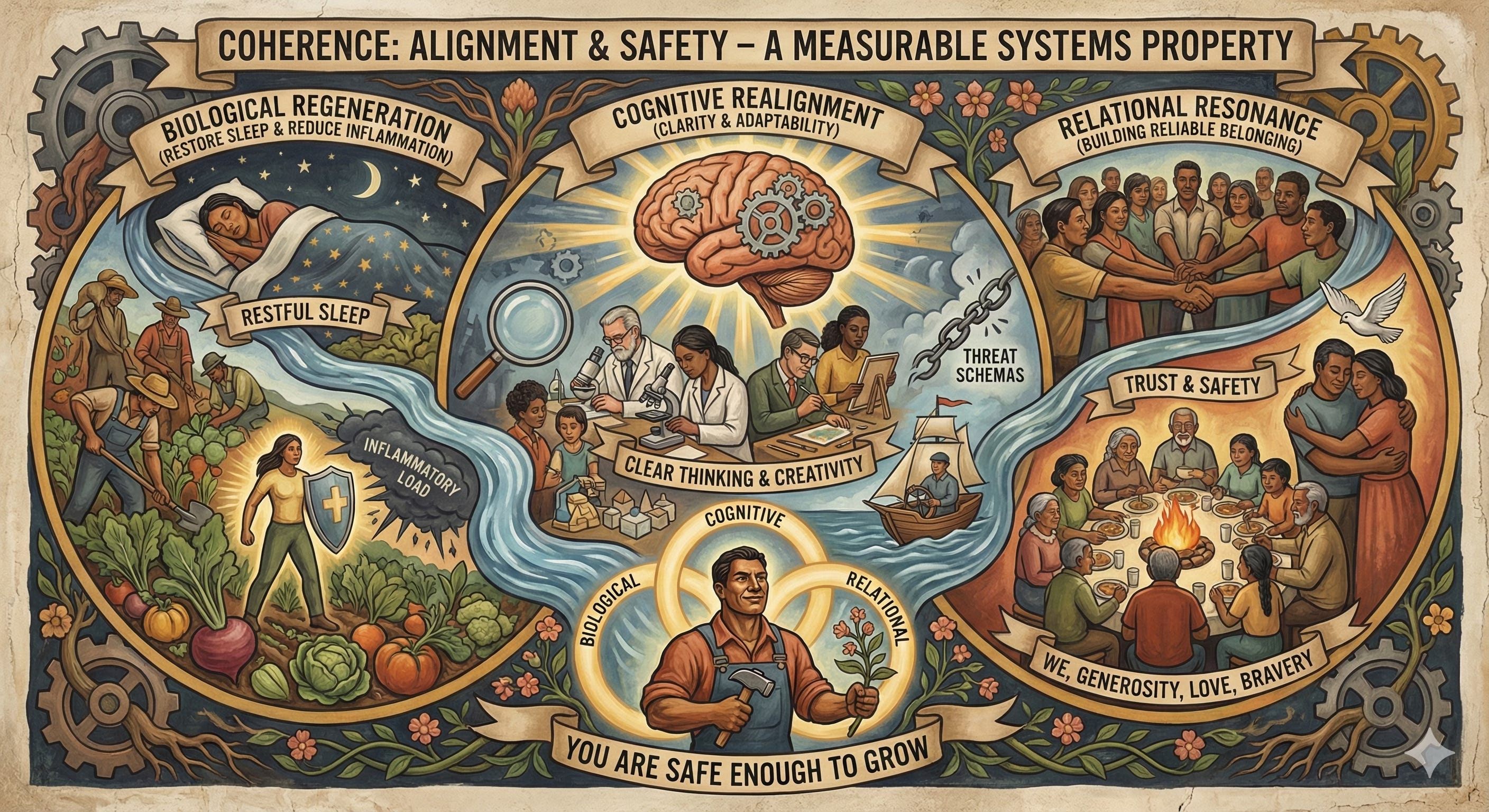
Coherence is not the absence of stimulation or emotion. It is alignment across biological, cognitive, and relational systems around a single message:
You are safe enough to grow.
When this alignment emerges, inflammation softens, attention widens, decision-making becomes more flexible, learning accelerates, and relationships deepen.
Cognition and immunity are not separate domains. They are parts of a single integrated system attempting to predict and regulate the future.
Coherence is not a metaphor.
It is a measurable systems property.
Restoring Coherence
There can never be a single intervention to restore coherence.
Coherence emerges when multiple systems realign.
Biological coherence comes from restoring sleep, reducing inflammatory load, and lowering chronic threat signaling.
Cognitive coherence comes from retraining threat-biased schemas, strengthening attentional control, and reducing constant prediction error.
Relational coherence comes from increasing predictability, building reliable belonging, and reducing mixed signals.
Consistency is not rigidity.
It is how safety is learned.
The Adaptive Resilience View
There is a poetic framing that I believe captures the biology perfectly. Alejandro Jodorowsky wrote,
Pain rests in these four words:
I, possession, hate, and fear.
Incoherence is this state translated into physiology.
Coherence becomes generative when the system opens toward:
We, generosity, love, and bravery.
The cost of incoherence is paid in inflammation, rigidity, loneliness, exhaustion, and shortened life.
The reward of coherence is paid in Clarity, Vitality, Flow, and Connection.
I call this lens Adaptive Resilience because it shifts the focus from fixing individuals to restoring coherence across systems. That framing carries responsibility. It means being careful not to reduce complex biology to slogans, not to weaponize science for ideology, and not to confuse explanation with excuse.
If incoherence is a systems problem, then coherence can be cultivated deliberately, without blame.
References
Slavich, G. M. (2020). Social Safety Theory: A biologically based evolutionary perspective on life stress, health, and behavior. Annual Review of Clinical Psychology, 16, 265–295. https://doi.org/10.1146/annurev-clinpsy-032816-045159
Slavich, G. M., Mengelkoch, S., & Cole, S. W. (2023). Human social genomics: Concepts, mechanisms, and implications for health. Lifestyle Medicine, 4(2), e75. https://doi.org/10.1002/lim2.75
Irwin, M. R., & Cole, S. W. (2011). Reciprocal regulation of the neural and innate immune systems. Nature Reviews Immunology, 11, 625–632. https://doi.org/10.1038/nri3042
Dantzer, R., et al. (2008). From inflammation to sickness and depression: When the immune system subjugates the brain. Nature Reviews Neuroscience, 9, 46–56. https://doi.org/10.1038/nrn2297
Coelho, D. R. A., et al. (2025). Association Between Inflammatory Markers and Cognitive Function in Adults With Bipolar Disorder: A Systematic Review. Acta Psychiatrica Scandinavica. https://doi.org/10.1111/acps.13824
Muscatell, K. A., Moieni, M., Inagaki, T. K., et al. (2016). Exposure to an inflammatory challenge enhances neural sensitivity to negative and positive social feedback. Brain, Behavior, and Immunity, 57, 21–29. https://doi.org/10.1016/j.bbi.2016.03.022
Muscatell, K. A., Dedovic, K., Slavich, G. M., et al. (2016). Neural mechanisms linking social status and inflammatory responses to social stress. Social Cognitive and Affective Neuroscience, 11(6), 915–922. https://doi.org/10.1093/scan/nsw025