

Pressure is no longer something that arrives in waves.
It’s now the very atmosphere we live in.
Uncertainty hums in the background of modern life. Institutions wobble. Systems fray. Stress accumulates faster than most people can metabolize it.
And yet, a certain kind of person becomes steadier, clearer, and more grounded, even as the world grows more unpredictable.
Not because their lives are easier, but because the architecture inside them is different.
This is the essence of Adaptive Resilience: the ability to regenerate through disruption instead of folding beneath it.
Why Some People Flourish While Others Fragment
When life starts to tilt, most people default to instinct:
Push harder
Pull away
Try to control what cannot be controlled
Seek distraction
Fold inward
These are not moral failings.
They’re human biological reactions to threat.
But they are not the pathways to resilience.
Resilience isn’t force.
It isn’t enthusiasm.
It isn’t toughness or mindset.
Resilience is the ability to stay flexible, clear, and connected when reality becomes volatile, and to regenerate after insult or injury.
The Four Capacities of Inner Architecture
Across cultures, disciplines, and scientific fields, people who adapt well share four internal capacities.
1. Clarity
The ability to see what is actually happening without the distortion of fear or wishful thinking.
2. Strength
Not the strength of resistance, but the strength of capacity: the nervous system’s ability to hold complexity without cracking.
3. Flow
The capacity to adapt rather than brace. To move with change instead of becoming rigid in the face of it.
4. Connection
The understanding—validated again and again in the science of well-being—that human beings flourish through relationship, meaning, and contribution.
These four capacities don’t arise from discipline alone.
They emerge from the biology beneath them.
What Most People Miss About Flourishing
We often describe suffering and stagnation as psychological failures—but many of them originate in physiology.
Our best science shows:
Chronic stress alters immune tone and cognition
Poor sleep shifts emotional regulation and threat perception
Inflammation predicts depressive symptoms in some people
Autonomic imbalance reduces cognitive flexibility
This doesn’t mean that anxiety is inflammation or that rigidity is microglial priming. Those are oversimplifications.
But it does mean that biology is woven deeply into every experience we call “emotional.”
Philosophical teachings that point to how togetherness, generosity, love, and bravery create happiness within us sound poetic, but this mirrors the nervous system.
Self-protection narrows the world.
Connection broadens it.
Threat makes the mind tunnel.
Safety makes the mind spacious.
This is biology, not metaphor.
A New Approach to Human Growth
We do not need more hacks, more optimization, or more pressure to become superhuman.
We need environments—internal and external—that help human systems function the way they evolved to function.
Environments that:
Reduce physiological noise
Stabilize energy
Widen perceptual bandwidth
Support emotional range
Enhance cognitive flexibility
Deepen relational capacity
Sustain meaning
And allow regeneration instead of depletion
Adaptive Resilience is the study of that architecture—and the practice of building it.
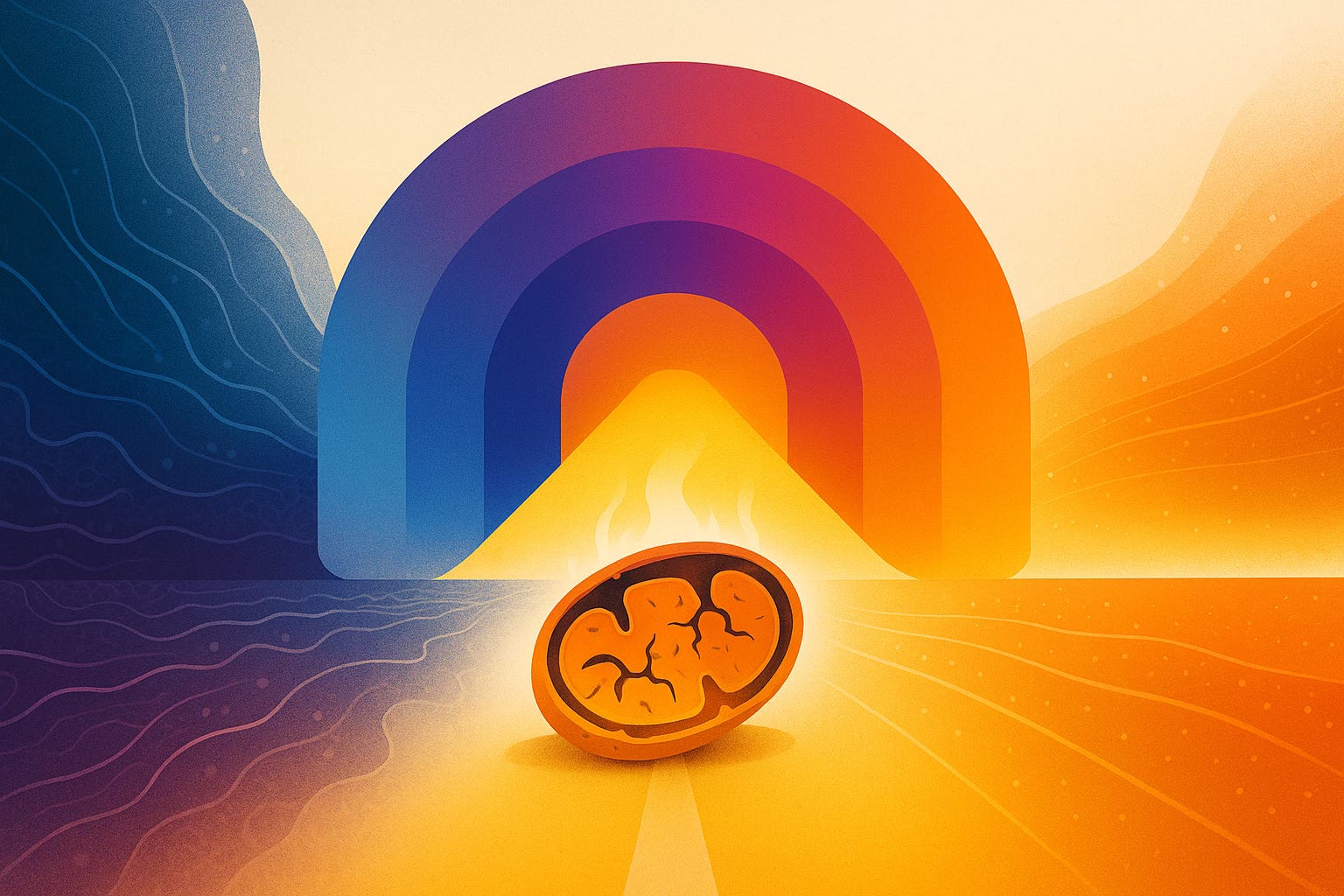
The World’s Instability Is Increasingly Physiological, Not Just Psychological
Over the past decade, the forces shaping human behavior have moved decisively into the realm of physiology. High-quality research across stress biology, sleep science, immunology, and bioenergetics reveals a clear pattern: modern life is overwhelming biological systems faster than they can recover.
Here are the four most robust indicators:
Chronic stress is reshaping immune tone and cognition.
George Slavich’s “Social Safety Theory” synthesizes evidence that ongoing social and environmental threat activates conserved inflammatory programs and alters neural circuits involved in vigilance, threat detection, and executive function. Stress becomes a biological signaling event before it becomes a conscious feeling.1
Sleep depth is declining, impairing emotional stability and network dynamics.
Eti Ben-Simon and Matthew Walker show that even modest sleep loss increases amygdala reactivity, weakens prefrontal control, and disrupts large-scale brain networks fundamental to clarity and cognitive flexibility. Sleep is not simply rest; it is an essential regulator of emotional intelligence and social behavior.23
Low-grade inflammation is shaping mood, motivation, and decision-making.
Meta-analytic work confirms that a subset of individuals with depressive symptoms exhibit elevated immune cells in their blood: CRP, IL-6, and TNF-α. Complementary neuroimaging studies show that inflammation reduces reward responsiveness and alters connectivity in circuits governing motivation and effort. Inflammatory tone subtly shifts the cost of cognitive and emotional labor.456
Metabolic dysfunction is impairing cellular energetics and neural signal quality.
Martin Picard’s work on “mitochondrial allostatic load” shows how chronic stress remodels mitochondrial structure and function, altering the energetic resources available to the brain. New research reinforces that mitochondria act as dynamic living signaling networks whose state influences neural fidelity, stress responses, and cognitive stability.789
These findings converge on a single insight:
People are not merely psychologically strained. They are physiologically overloaded.
And any modern framework for resilience must begin at that level.
What’s Coming Next
I’ll break down:
The four-pillar model
The physiological systems that scaffold resilience
How inflammation, sleep, and autonomic balance shape clarity
How immune tone influences emotional life
How energy quality shapes thought quality
The science of co-regulation and connection
Daily habits that shift the nervous system toward repair instead of defense
This isn’t about perfection.
It’s about designing the conditions under which a human being can truly flourish—even in a world that isn’t slowing down.
Why This Matters Now
The world is not trending toward stability.
But you can.
And when your internal architecture stabilizes, a quiet transformation begins:
Stress stops overwhelming you.
Change stops destabilizing you.
Complexity stops confusing you.
Illness fades.
Relationships deepen.
Meaning returns.
Clarity rises with less effort.
This is flourishing in real life. Not in ideal circumstances, but in the world exactly as it is.
It begins with a shift that science supports:
Stop blaming yourself for biological patterns you were never taught to recognize.
Next: the physiology that makes resilience possible.
Slavich, G. M. (2020). Social safety theory: A biologically based evolutionary perspective on life stress, health, and behavior. Annual Review of Clinical Psychology, 16, 265–295. https://doi.org/10.1146/annurev-clinpsy-032816-045159
Ben-Simon, E., & Walker, M. P. (2018). Sleep loss causes social withdrawal and loneliness. Nature Communications, 9, 3146. https://doi.org/10.1038/s41467-018-05377-0
Ben-Simon, E., Vallat, R., Barnes, C. M., & Walker, M. P. (2020). Sleep loss and the socio-emotional brain. Trends in Cognitive Sciences, 24(6), 435–450. https://doi.org/10.1016/j.tics.2020.02.003
Osimo, E. F., Baxter, L. J., Lewis, G., & Jones, P. B. (2020). Inflammatory markers in depression: A meta-analysis of mean differences and variability in 5,166 patients and 5,083 controls. Brain, Behavior, and Immunity, 87, 901–909. https://doi.org/10.1016/j.bbi.2020.02.010
Osimo, E. F., Baxter, L. J., Lewis, G., & Jones, P. B. (2020). Inflammatory markers in depression: A meta-analysis of mean differences and variability in 5,166 patients and 5,083 controls. Brain, Behavior, and Immunity, 87, 901–909. https://doi.org/10.1016/j.bbi.2020.02.010
Felger, J. C., Haroon, E., Patel, T. A., Goldsmith, D. R., Wommack, E. C., Woolwine, B. J., … & Miller, A. H. (2018). What does plasma CRP tell us about peripheral and central inflammation in depression? Molecular Psychiatry, 25(6), 1301–1311. https://doi.org/10.1038/s41380-018-0096-3
Picard, M., & McEwen, B. S. (2018). Psychological stress and mitochondria: A conceptual framework. Psychosomatic Medicine, 80(2), 126–140. https://doi.org/10.1097/PSY.0000000000000544
Monzel, A. S., Enríquez, J. A., & Picard, M. (2023). Multifaceted mitochondria: Moving mitochondrial science beyond function and dysfunction. Nature Metabolism, 5, 546–562. https://doi.org/10.1038/s42255-023-00783-1
Trumpff, C., Picard, M., & et al. (2024). Psychosocial experiences are associated with human brain mitochondrial biology. Proceedings of the National Academy of Sciences, 121(27), e2317673121. https://doi.org/10.1073/pnas.2317673121