

It is easy to think of conflict as a failure of belief.
I’ve said it before: “Belief” without revision is just a frozen emotion pretending to be a fact. A feeling of certainty.
People disagree. They choose sides. They harden. We tell ourselves that what divides us is what we think — our values, our ideologies, our conclusions about the world. That is the vocabulary we have built to explain rupture, and it is a comfortable vocabulary, because it implies that the solution is also ideological. Change the mind, change the outcome.
But what if conflict begins earlier than that? What if it begins at the point where difference stops being tolerable — not because the difference has changed, but because the organism encountering it has?
This is not a philosophical abstraction. It is an empirical question. And it becomes very difficult to ignore once you look closely at what happened just this month in the middle of a Ugandan rainforest.
The War No One Expected
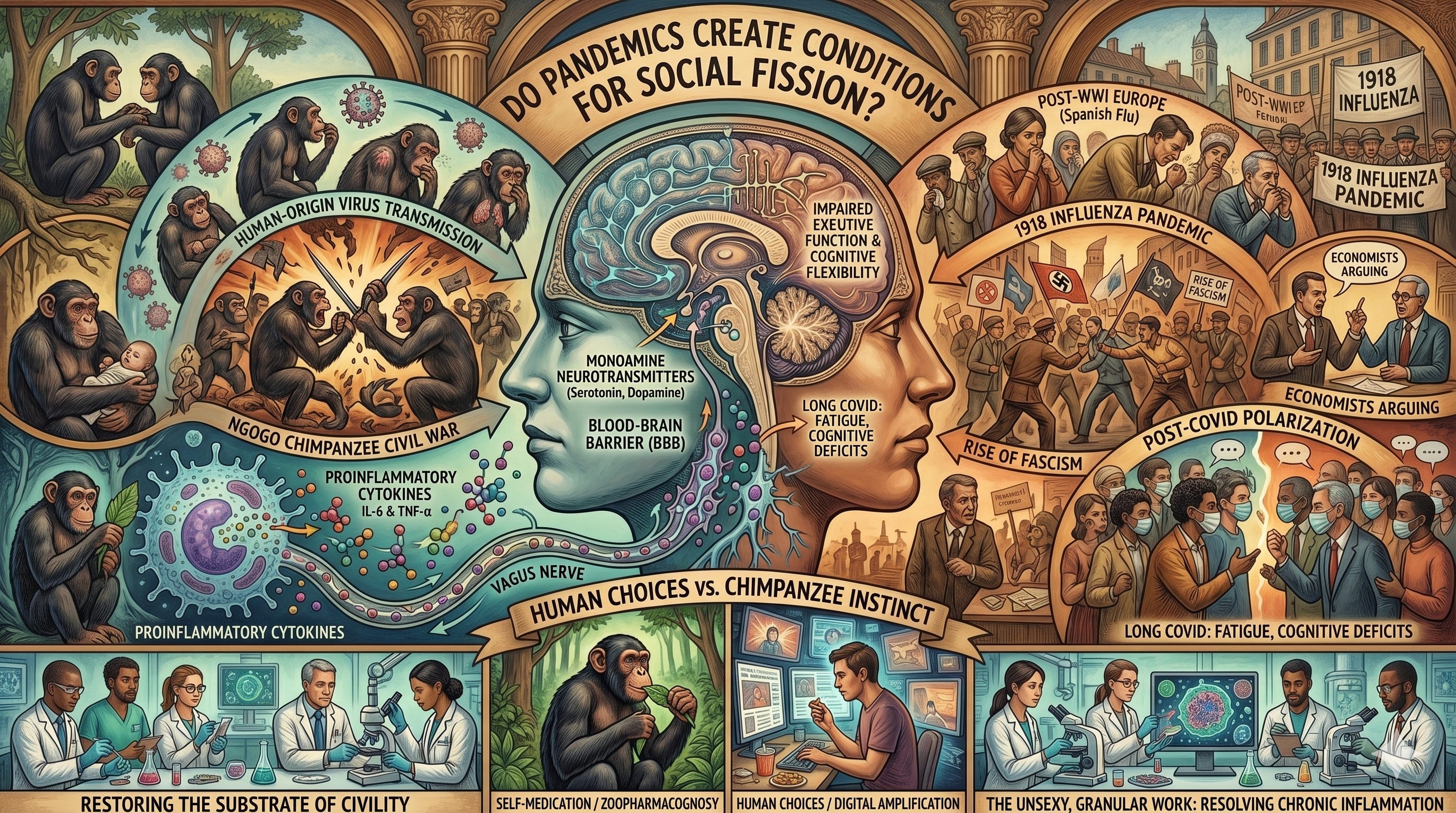
In April 2026, a landmark study in Science1 confirmed what primatologists had been watching with growing horror for nearly a decade. The Ngogo chimpanzee community in Uganda’s Kibale National Park — once the largest known group of wild chimpanzees, roughly 200 individuals who had lived together in relative cohesion for at least twenty years — had fractured into two hostile factions. The Western group began conducting targeted raids into Central territory. At least 28 chimpanzees have been killed, including 19 infants. Every casualty has come from one side. Lead researcher Aaron Sandel has described it, without exaggeration, as a civil war.
The coverage has been extraordinary. Nearly every major outlet has emphasized the same frame: social networks fractured, and violence followed. The study traced thirty years of data and identified a tipping point in 2015, when Western and Central clusters stopped intermingling. By 2017, their ranges no longer overlapped. By 2018, the killing started.
The narrative is tidy. Networks deteriorated. Bridge individuals died. Polarization escalated. War.
That narrative is correct. It is also incomplete. Because embedded within the study’s own timeline is a detail that almost no one is talking about — one that points to a far more unsettling mechanism than social networks alone.
The Detail Everyone Is Skipping
Among the factors the authors identify as potential catalysts for the split: in 2014, five adult males and one adult female died after showing signs of illness. Scientists described in detail how their deaths weakened the connections between clusters.
In 2015, the alpha male changed. And then, in January 2017, a massive respiratory disease swept through Ngogo. A viral epidemic.
It killed twenty-five chimpanzees. Four adult males. Ten adult females. The epidemic was caused by two distinct human-origin respiratory viruses — human metapneumovirus and human respirovirus 3 — transmitted from people to apes.
Among the dead were the last individuals who maintained friendships across both factions.
The researchers are careful to note that polarization was already underway before the epidemic hit. They are right. But let’s consider the sequence more carefully. The community was stressed. Key connectors had died. A new alpha was asserting dominance. And then a wave of infectious disease tore through the population, disproportionately killing the adults who still held the fraying threads together.
The epidemic did not start the split. But it may have made the split irreversible.
Fission.
Now here is the question that no one seems to be asking: what did that epidemic do to the survivors’ physiology?
The Biology Underneath the Network
We are comfortable describing what happened to the Ngogo community’s social structure. We are far less comfortable asking what happened to the physiology of the animals who make up that structure.
This is where the story gets uncomfortable, because it requires us to take seriously a causal chain that runs beneath the level of choice, strategy, or social organization. It runs through the immune system.
When a respiratory virus tears through a population, the survivors are not simply reorganized. They carry forward a physiological burden. The immune response to severe infection triggers a cascade of pro-inflammatory cytokines — molecules like interleukin-6 (IL-6) and tumor necrosis factor-alpha (TNF-α) — that do not politely confine themselves to fighting the foreign, anthroponotic virus. They cross into the central nervous system through multiple pathways: active transport across the blood-brain barrier, stimulation of the vagus nerve, and diffusion through circumventricular organs.
Once in the brain, these inflammatory signals interact with nearly every system relevant to behavior. The research here is robust and converging. Pro-inflammatory cytokines alter the metabolism of monoamine neurotransmitters — serotonin, dopamine, norepinephrine — that regulate mood, motivation, and cognitive flexibility. IL-6 and TNF-α have been reliably found at elevated levels in patients with major depression across multiple meta-analyses. Neurovegetative symptoms like fatigue and anergia correlate specifically with changes in basal ganglia activity, likely tied to disrupted dopamine metabolism. And the cognitive domain most consistently impaired? Executive function. The capacity for perspective-shifting, behavioral inhibition, and flexible response to novel social information.
In plain language: systemic inflammation makes it metabolically expensive to hold complexity. To tolerate ambiguity. To extend the benefit of the doubt.2
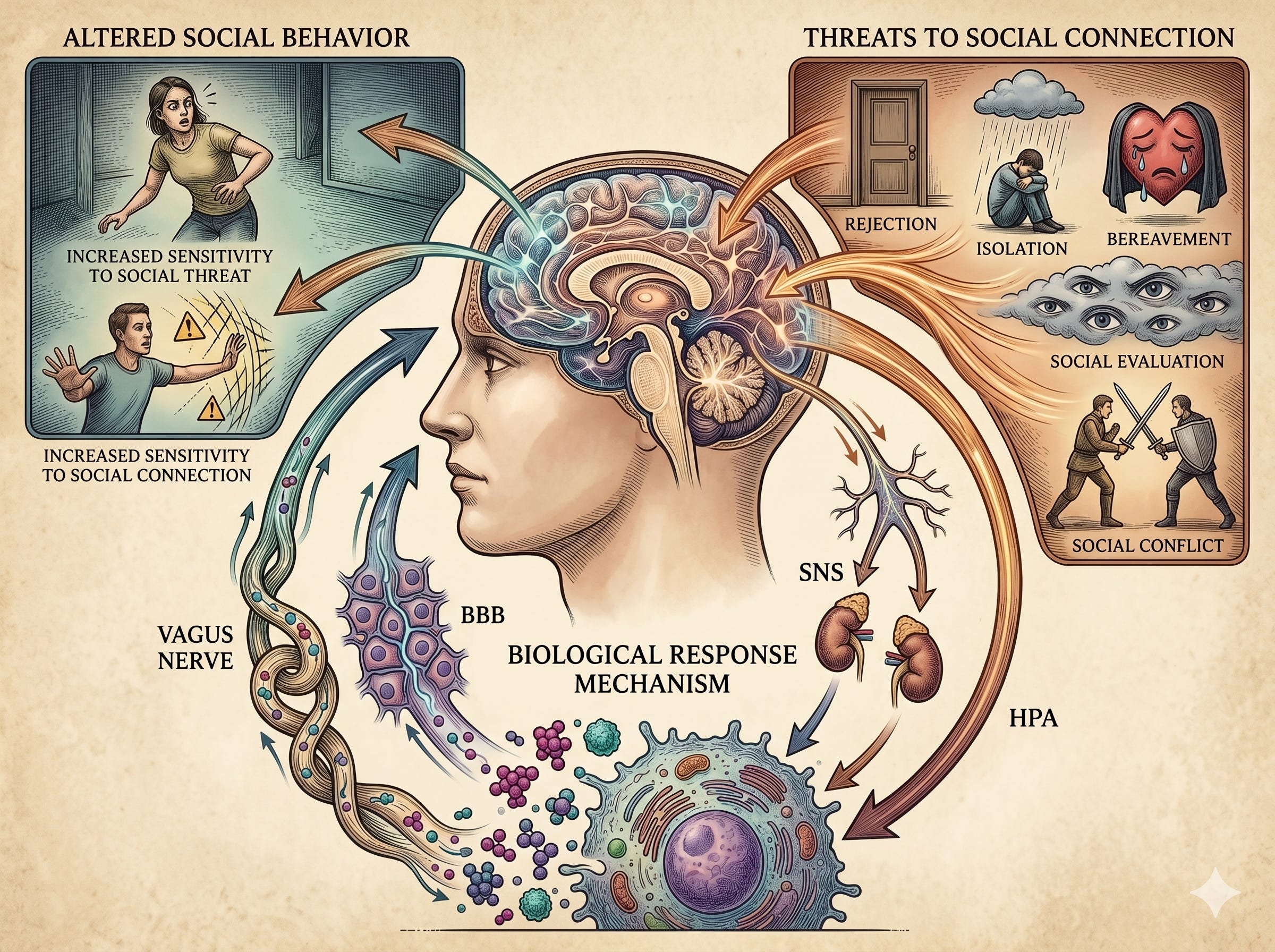
This is not a metaphor. It is a measurable reduction in the neurochemical substrate of social flexibility.3
Reframing the Hypothesis
So let me pose the question directly, because I think it deserves to be stated plainly before we hedge it:
Do pandemics create the physiological conditions necessary for social fission?
Not the only conditions. Not sufficient conditions. But necessary ones — the kind that narrow the range of possible social responses until what was once manageable tension becomes unmanageable threat.
The standard account of conflict runs through ideology, identity, competition, and leadership. Those explanations are real. But they describe the content of conflict — what people (or chimps) fight about. They rarely describe the threshold — the point at which a population loses the capacity to absorb the stresses that it was previously absorbing, and regenerate and grow after the wound.
Inflammation shifts that threshold. It does so not by changing what organisms believe, but by changing what they can afford to process. If dopaminergic flexibility is the currency of social tolerance, then a population carrying chronic inflammatory burden is a population running a cognitive deficit that no ideology can fix.
The Ngogo chimpanzees did not develop ethnic identities or political ideologies. They did not watch cable news or sort themselves by zip code. They had no religion, no known language of grievance, no propaganda. And yet a community that had lived together for decades fractured with extraordinary violence, even cruelty.
The researchers themselves emphasize this: the split demonstrates that cultural markers are not necessary for civil war. Shifting social relationships alone can fracture a group.
But I want to push further. Why did the relationships shift? Not only because bridge individuals died — though they did. Not only because the group was too large — though it was. But perhaps also because the survivors of a devastating epidemic were carrying immune systems that had been reprogrammed for threat detection, with diminished neurochemical capacity for the kind of flexible, costly social maintenance that holds a large group together.
Three Epidemics, Three Fractures
If this hypothesis has merit, we must find the pattern repeating. We do.
Gombe, Tanzania, 1970s. Jane Goodall’s famous community split — the only other documented chimpanzee civil war — has always been controversial. Some primatologists attributed it to Goodall’s banana provisioning stations, which artificially concentrated chimpanzees, intensified competition, and may have facilitated disease transmission between humans and apes. The Ngogo study’s authors note that their case is the first fission observed without a history of food provisioning, implicitly distinguishing it from Gombe. But what both sites share is a documented history of anthroponotic respiratory disease outbreaks transmitted from humans to chimpanzees. Gombe’s chimps suffered repeated epidemics, and forty-seven years of data show that illness was the leading cause of death — 58% of deaths with known cause — followed by intraspecific aggression at 20%.
The banana stations may have been a vector not primarily of competition, but of pathogen exposure.
What if Jane Goodall was not only a brilliant researcher, and someone who loved learning about our closest relatives, but someone also inadvertently destroyed the society she studied?
Post-WWI Europe, 1918–1933. The 1918 influenza pandemic killed at least fifty million people worldwide and over 400,000 in Germany alone — more than German military casualties in the same year. Researchers at IZA have shown that German constituencies with higher Spanish flu mortality exhibited significant shifts in voting patterns in subsequent elections. A study published in the American Journal of Public Health found that Italian cities with higher influenza mortality showed greater support for Fascism. Separately, economists have documented that countries more affected by the pandemic adopted significantly more protectionist trade policies in the following decade. The standard explanation for interwar radicalization focuses on the war, reparations, and economic humiliation. But the pandemic was simultaneous, massive, and systematically ignored by historians until very recently. A population carrying the inflammatory aftermath of H1N1 — layered onto the physical and psychological devastation of industrial war — would have been operating with profoundly diminished cognitive flexibility. The rise of authoritarian politics may not have been solely a failure of institutions. It may also have been a failure of metabolic budget.
Post-COVID Earth, 2020–present. Multiple inflammatory markers — IL-6, TNF-α, C-reactive protein — are significantly elevated in COVID-19 patients and remain elevated in many long-COVID cases. A meta-analysis of post-COVID sequelae estimates that 32% of patients experience prolonged fatigue and 22% experience cognitive deficits, both associated with increased neuroinflammation. Studies in children found significant decreases in prosocial behavior scores after COVID infection, alongside increases across all problem behavior scales. Executive function — the domain governing attention-shifting, behavioral inhibition, and cognitive flexibility — is among the most consistently impaired. Meanwhile, measures of political polarization, institutional distrust, and social fragmentation have intensified globally since 2020. The conventional explanation attributes this to lockdowns, misinformation, and political opportunism. Those explanations are not wrong. But they do not account for the possibility that hundreds of millions of people are carrying a neuroinflammatory burden that makes social tolerance biologically more expensive than it was four years ago.
The influence of lockdowns, misinformation, and political opportunism might be a drop in the bucket compared to the physiological drivers.
The Intelligence Inversion
Here is where the story takes its most counterintuitive turn.
We assume that our intelligence makes us more resilient than chimpanzees in the face of these pressures. The opposite may be true.
Chimpanzees practice a form of self-medication that primatologists call zoopharmacognosy. When ill, they seek out specific bitter plants with anti-parasitic and anti-inflammatory properties. They have no theory of immunology. They cannot explain why the leaves help. But they move toward the intervention.
Humans, equipped with entire sciences devoted to inflammation, often do the opposite. When our systems are under stress, we reach for the things that amplify it: ultra-processed foods that drive metabolic inflammation, digital media environments optimized to trigger threat-detection circuits, sleep patterns disrupted by artificial light, increased consumption of porn, alcohol, and drugs, and social isolation rationalized as “self-care”. We are intelligent enough to build environments that systematically override the recovery mechanisms that a chimpanzee follows by instinct.
The chimpanzee is constrained by its ecology to heal. We are sophisticated enough to choose not to.
This is not an argument against human intelligence. It is an argument about what intelligence costs when it is deployed without awareness of its own biological substrate. A species that can build institutions, craft treaties, and reason about justice can also build feed algorithms that keep the amygdala perpetually activated, design food systems that maximize palatability at the expense of metabolic health, and construct work cultures that treat sleep deprivation as a signal of commitment. The cognitive flexibility that is supposed to be our great advantage is also the thing we are most efficiently degrading.
What Capacity Means
We tend to read stories of conflict at the level of motive. Who gained, who lost, what ideological incentives shifted. What we rarely ask is whether the range of possible responses had already narrowed before the first argument began.
The Ngogo researchers describe a community in which chimpanzees who had groomed together, hunted together, and held hands before confronting outside groups became enemies within a few years. Sandel says he feels like a war correspondent. Mitani, who studied these animals for two decades, worries they are witnessing an extinction event.
What I want to suggest — carefully, because the evidence is not yet causal in the way we would want it to be — is that this story is not only about chimpanzees losing their social bridges. It is about organisms whose inflammatory and neuroimmune burden reduced their capacity for the kind of costly, flexible social behavior that maintains bridges in the first place.
And if that is true, then the lesson is not about chimpanzees.
We have been living, for the past six years, through and after a pandemic that infected billions. We know that COVID-19 triggers neuroinflammation. We know that chronic inflammation strongly impairs executive function and cognitive flexibility. We know that prosocial behavior declines measurably after infection. And we know that the social fabric of almost every democratic society on earth has frayed dramatically during the same period.
We also know that the burden of disease was not evenly distributed. In the United States, worse outcomes from COVID-19 — including hospitalization and death — were concentrated among populations with higher baseline vulnerability: poorer, higher rates of chronic disease, and reduced access to care. Vaccination significantly reduced severe outcomes at the population level, but uptake and response varied across groups, often tracking the same underlying gradients of health, trust, and access. The result was not just unequal mortality, but unequal physiological strain. The same populations that were most exposed to stressors — metabolic, environmental, social — were also those most likely to experience the heaviest inflammatory burden during and after infection.
We attribute this fraying to politics, to social media, to culture wars. Those attributions are not wrong. But they may be dangerously incomplete — because they suggest that the solution is better arguments, better platforms, better leaders. And if part of the problem is physiological, then purely ideological interventions will always keep failing in ways we cannot continue to explain without Clarity.
The Work Ahead
I am not arguing for biological determinism. The bonobo — equally closely related to us as the chimpanzee — split from its Wamba community fifty years ago and the two groups coexist peacefully to this day. Our evolutionary past does not dictate our future. But it does define the playing field on which our choices operate, and if that field has been tilted by a global inflammatory event, we need to know.
The research agenda this implies is straightforward, even if it is not yet complete: longitudinal studies tracking inflammatory markers alongside measures of social trust, prosocial behavior, and cognitive flexibility in post-COVID populations. Controlled interventions testing whether resolving chronic inflammation restores measurable social capacity. Epidemiological analyses of whether regions with higher COVID burden show faster deterioration in measures of social cohesion, controlling for political and economic variables.
Some conflicts are not chosen so much as reached — arrived at the edge of what a body can sustain. The Ngogo chimps did not decide to go to war. They reached a point where the metabolic cost of maintaining peace exceeded what their depleted systems could pay.
If that framing has any validity for human societies, then the most urgent work is not more persuasion, more dialogue, more calls for civility. It is the unsexy, granular, biological work of restoring the substrate on which civility depends.
I’ve said it before: “Belief” without revision is just a frozen emotion pretending to be a fact. A feeling of certainty. We cannot argue or debate our way into tolerance if “the machinery of tolerance” is running on empty.
Restoring the Capacity for Cohesion
This is where Adaptive Resilience becomes less abstract and more urgent. If the capacity for tolerance, flexibility, and cooperation is biologically mediated, then it can also be biologically degraded — and restored. The question is no longer just how we persuade each other, but how we rebuild the underlying systems that make persuasion possible. Because a society does not fracture only when its ideas diverge. It fractures when its members lose the capacity to hold those differences without shattering.
This is the first entry in a series exploring the neuroimmune foundations of social behavior through the lens of the Adaptive Resilience framework. Next: what specific physiological interventions — from resolving chronic inflammation to buffering prefrontal metabolic demand — might constitute genuine acts of social preservation.
Aaron A. Sandel et al. Lethal conflict after group fission in wild chimpanzees. Science 392, 216–220 (2026). https://doi.org/10.1126/science.adz4944
Naomi I. Eisenberger, Mona Moieni, Tristen K. Inagaki et al. In sickness and in health: The co-regulation of inflammation and social behavior. Neuropsychopharmacology 42, 242–253 (2017). https://doi.org/10.1038/npp.2016.141
Jennifer C. Felger, Michael T. Treadway. Inflammation effects on motivation and motor activity: Role of dopamine. Neuropsychopharmacology 42, 216–241 (2017). https://doi.org/10.1038/npp.2016.143